
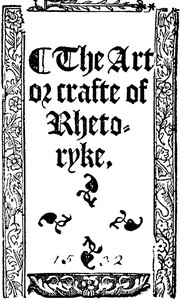
The Art or Crafte of Rhetoryke by Leonard Cox
Forget everything you think you know about old grammar books. Leonard Cox's The Art or Crafte of Rhetoryke isn't about diagramming sentences. Published in the 1520s, it was the very first manual of its kind written in English. Before this, if you wanted to learn the art of persuasive speaking (rhetoric), you had to read complex Latin texts. Cox changed the game by translating and adapting these classical ideas for a whole new audience: everyday English speakers, merchants, students, and anyone who needed to make a compelling case.
The Story
There isn't a plot in the traditional sense. Instead, think of the book as a masterclass. Cox breaks down the ancient system of rhetoric into clear, usable parts. He explains how to invent your arguments, how to arrange them for maximum impact, how to style your language to be memorable, how to commit your speech to memory, and finally, how to deliver it with force. He uses examples from famous orators like Cicero and applies their lessons to the concerns of 16th-century life. The 'story' is the reader's own potential journey from being a passive listener to becoming an effective, persuasive voice.
Why You Should Read It
Reading Cox is a revelation. You realize that the strategies for convincing people haven't changed much in 500 years. When he talks about appealing to an audience's emotions or building a logical case, it sounds exactly like advice you'd hear in a modern politics, marketing, or law seminar. It pulls back the curtain. It makes you see the mechanics behind every powerful sermon, political speech, or even a compelling product review. You start to spot these ancient techniques everywhere in today's world. It’s also humbling and fascinating to see this knowledge, once confined to scholars, being packaged for the public. Cox was democratizing power, one rhetorical device at a time.
Final Verdict
This book is perfect for history buffs who love seeing the roots of modern ideas, for writers and communicators curious about the timeless tools of their trade, and for anyone who enjoys a good 'aha!' moment. It's not a cover-to-cover page-turner; it's a book to dip into and ponder. If you've ever wondered why some arguments stick and others fade, Cox provides the original playbook. Approach it not as a dusty rulebook, but as a fascinating conversation with the past about a skill that is more relevant now than ever.
This text is dedicated to the public domain. It is available for public use and education.
Sarah Jackson
9 months agoMy first impression was quite positive because the author clearly has a deep mastery of the subject matter. Finally, a source that prioritizes accuracy over hype.
Kimberly Lee
1 month agoThe clarity of the introduction set high expectations, and the wealth of information provided exceeds the average market standard. Top-tier content that deserves more recognition.
Paul Wilson
6 months agoI wanted to compare this perspective with traditional views, the inclusion of diverse viewpoints strengthens the overall narrative. I am looking forward to the author's next publication.
Linda Garcia
3 months agoAfter spending a few days with this digital edition, the evidence-based approach makes it a very credible source of information. A refreshing and intellectually stimulating read.





Matthew Thompson
6 months agoBefore I started my latest project, I read this and the language used is precise without being overly academic or confusing. This is a solid reference for both beginners and experts.