
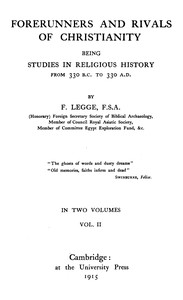
Forerunners and rivals of Christianity : being studies in religious history…
So, what's this book actually about? Francis Legge, writing over a century ago, takes us on a tour of the religious scene before and during Christianity's early days. He argues that to understand Christianity's explosive growth, you need to understand the soil it grew in. This wasn't empty ground.
The Story
Legge doesn't give us a single narrative but explores a whole cast of spiritual characters. He introduces us to the Mystery Religions from places like Greece and Egypt—cults where initiates underwent secret rituals for a better afterlife. He looks at the influence of Greek philosophers, especially the Stoics and Platonists, whose ideas about God, logos (the 'Word'), and ethics paved intellectual roads. He also examines the spread of Eastern faiths, like the worship of the Persian god Mithras or the Egyptian goddess Isis, who were competing for the hearts of Roman soldiers and citizens. The book shows how these movements shared common themes: a dying and rising savior god, ritual purification, and the promise of personal salvation. Legge's 'plot' is the collision and combination of all these ideas, setting the stage for a new faith that would ultimately absorb, reject, and surpass them.
Why You Should Read It
Here's why I found it so compelling: it adds layers of context I never had. Reading this, you stop seeing early Christianity as a bolt from the blue and start seeing it as part of a massive, ongoing conversation. It makes the New Testament letters feel more urgent—you understand what Paul was arguing against as much as what he was arguing for. While some of Legge's 1900s scholarship is dated, his core insight remains powerful: no religion, no matter how revolutionary, is created in a vacuum. It challenged my assumptions and made that ancient world feel crowded, competitive, and alive with spiritual searching. It's less about diminishing Christianity and more about understanding the rich, complicated world it transformed.
Final Verdict
This is a book for the curious. It's perfect for history buffs, anyone interested in comparative religion, or Christians looking to deepen their understanding of their faith's historical context. A word of caution: it's an old academic text, so the language can be dense in spots. But if you're willing to push through, the perspective it offers is incredibly rewarding. Don't read it for the final word on the subject—read it as a fascinating, foundational piece of the puzzle, written by a detective piecing together the spiritual landscape that changed the world.
You are viewing a work that belongs to the global public domain. Distribute this work to help spread literacy.
Linda Perez
11 months agoI found the author's tone to be very professional yet accessible, the practical checklists included are a great touch for real-world use. I'll be recommending this to my students and colleagues alike.





Charles Davis
1 year agoThe clarity of the concluding remarks is very professional.