
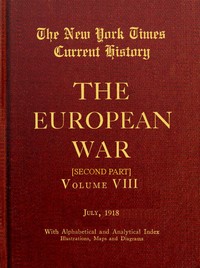
New York Times Current History: The European War, Vol. 8, Pt. 2, No. 1, July…
Let's be clear: this isn't a book with a plot in the traditional sense. There's no main character, unless you count the collective anxiety of a world at war. 'The European War' is a primary source, a bound collection of the New York Times' monthly reports from the first global conflict. The July 1915 issue captures a specific, grim moment. The early, mobile war has frozen into the horror of trench warfare on the Western Front. Major offensives are failing with staggering losses, and everyone is realizing this won't be over by Christmas.
The Story
Think of it as a snapshot. The 'story' is the war itself, told through official dispatches, military analyses, political speeches, and maps. One article might break down the failed Allied assault at Gallipoli. Another reprints a German general's assessment of the Eastern Front. There are casualty lists and debates about naval blockades. There's no single narrative thread guiding you; instead, you're plunged into the chaotic, information-heavy reality of the time. You read what a New York Times subscriber read over their breakfast, trying to piece together the truth from contradictory reports and soaring rhetoric.
Why You Should Read It
This is where it gets fascinating. Reading a modern history book gives you the clean, organized 'what happened.' Reading this gives you the messy, confusing 'what is happening?' You feel the uncertainty. The propaganda is obvious, but so is the genuine shock at the scale of the carnage. The language is formal, but the fear and nationalism pulse underneath. It completely strips away a century of hindsight. You see the war not as a series of known events, but as a terrifying present tense, with an unknown future. It makes the past feel immediate and human in a way polished narratives often don't.
Final Verdict
This is not for someone looking for a light narrative history. It's perfect for history buffs who want to get their hands dirty with primary sources, for writers seeking authentic period voice, or for any curious reader tired of textbook summaries. If you've ever visited a WWI memorial and wondered about the world that created those lists of names, this volume throws open a window to that very moment. It's challenging, sobering, and incredibly vivid.
This work has been identified as being free of known copyright restrictions. Use this text in your own projects freely.
Brian Jones
5 months agoAs someone who reads a lot, it challenges the reader's perspective in an intellectual way. I learned so much from this.
Richard Taylor
1 year agoI came across this while browsing and the pacing is just right, keeping you engaged. Exceeded all my expectations.
Kenneth Torres
2 years agoIf you enjoy this genre, the atmosphere created is totally immersive. A valuable addition to my collection.
Kevin Martin
7 months agoJust what I was looking for.

Patricia Johnson
1 year agoFrom a researcher's perspective, the nuanced approach to the central theme was better than I expected. This exceeded my expectations in almost every way.