
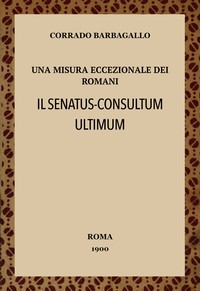
Una misura eccezionale dei Romani, Il senatus-consultum ultimum : (studio di…
Corrado Barbagallo's study tackles one of the most explosive concepts in Roman history: the Senatus Consultum Ultimum (SCU), often translated as the 'Final Decree of the Senate.' In simple terms, this was Rome's version of declaring martial law. When the Senate felt the Republic faced an immediate, existential threat—from internal rebellion or mob violence—it could pass this measure. It suspended normal legal protections and authorized the consuls to use any force necessary to 'see that the state takes no harm.'
The Story
The book isn't a novel with characters, but its narrative is driven by crisis. Barbagallo traces the life of this decree, starting with its dramatic and bloody debut. We see it first invoked against Tiberius Gracchus and later his brother Gaius, popular reformers whose actions the conservative Senate viewed as revolutionary. The decree justified their murders, setting a dangerous precedent. The story then follows the SCU through other major crises: the Jugurthine War, the rise of Marius and Sulla, the Catilinarian Conspiracy where Cicero famously used it, and finally, the political breakdown that led to Caesar crossing the Rubicon. Each use eroded the Republic's legal foundations a little more, turning an emergency tool into a common political weapon.
Why You Should Read It
What makes this book so compelling is its chilling relevance. Barbagallo, writing in the early 20th century, shows us the mechanics of democratic collapse. The SCU is a perfect case study of how fear can make a society trade liberty for security, and how that trade is almost always permanent. You watch well-meaning senators, convinced they are saving Rome, slowly dismantle the very system they swore to protect. It’s a masterclass in unintended consequences. The tension builds with each chapter, as the decree's use becomes more frequent and more blatantly political, leading inevitably to the end of the Republic and the rise of the Emperors.
Final Verdict
This is a book for anyone fascinated by political power, legal history, or the timeless question of how democracies die. It's perfect for readers who enjoyed Tom Holland's Rubicon or Mary Beard's SPQR but want to zoom in on a single, pivotal instrument of history. Be warned: it's a dense, academic work at its core, not a light read. But if you stick with it, you'll be rewarded with a profound understanding of one of the key reasons why the Roman Republic didn't just fade away—it was voted out of existence in a series of panicked, 'exceptional' measures.
No rights are reserved for this publication. You do not need permission to reproduce this work.
Mary Brown
1 month agoThe digital index is well-organized, making research much faster.
Oliver Hill
1 year agoI came across this while browsing and the clarity of the writing makes this accessible. I will read more from this author.
Charles Lopez
4 months agoMy professor recommended this, and I see why.
Robert Martin
8 months agoAfter finishing this book, the clarity of the writing makes this accessible. Definitely a 5-star read.




Patricia Wilson
10 months agoThe clarity of the introduction set high expectations, and the author clearly has a deep mastery of the subject matter. I'm genuinely impressed by the quality of this digital edition.