
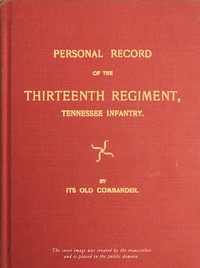
Personal record of the Thirteenth Regiment, Tennessee Infantry by Alfred J. Vaughan
Alfred J. Vaughan's Personal Record of the Thirteenth Regiment, Tennessee Infantry is exactly what the title promises: one man's account of leading a regiment through the American Civil War. Written in the war's immediate aftermath, it follows the unit from its enthusiastic formation in 1861 through its surrender in 1865. Vaughan traces their path across Tennessee, Mississippi, and Georgia, placing you in the thick of famous campaigns like Shiloh, Corinth, and the Atlanta Campaign. The narrative is built on official reports, but it's fleshed out with Vaughan's own clear memories and observations.
The Story
This isn't a novel with a single plot. It's the story of a group of men—farmers, shopkeepers, neighbors—who become soldiers. Vaughan starts with the regiment's patriotic raising and early confidence. He then guides you through the slow, hard turn of the war. You see the battles, but you also see the camp life, the sickness, the struggle for supplies, and the gradual wearing down of spirit and numbers. The story's arc is the transformation of a community into a battle-hardened, and ultimately defeated, military unit. The end isn't a victory parade; it's the quiet, painful dissolution of the regiment and the return of its survivors to a changed world.
Why You Should Read It
You should read this for the ground-level view. History books often talk about armies moving like chess pieces. Vaughan shows you the mud on the boots. His writing has a direct, almost urgent quality. He's not trying to write literature; he's trying to set the record straight for his men and for history. You feel his pride in their endurance and his grief over their losses. The real power isn't in grand speeches about causes, but in simple details: listing the names of the fallen, describing a successful capture of Union coffee (a major morale boost), or noting the weather on a particularly terrible march. It makes the war feel real, immediate, and deeply personal.
Final Verdict
This book is perfect for anyone interested in the Civil War beyond the generals and presidents. It's essential for those researching Tennessee's role or specific Western Theater campaigns. More broadly, it's for any reader who appreciates primary sources—hearing history directly from someone who lived it. It's not a light read, but it's a compelling one. If you want to understand the soldier's experience—the camaraderie, the hardship, the loss—from a commander who shared their dangers, Vaughan's personal record is a powerful place to start.
You are viewing a work that belongs to the global public domain. You are welcome to share this with anyone.
Kimberly Hernandez
5 months agoFrom a researcher's perspective, the critical analysis of current industry standards is very timely. A trustworthy resource that I'll keep in my digital library.
Mary Johnson
2 years agoIt took me a while to process the complex ideas here, but the author clearly has a deep mastery of the subject matter. A solid investment for anyone's personal development.
Susan Taylor
11 months agoOne of the most comprehensive guides I've read this year.
Robert Thompson
4 months agoThe author provides a very nuanced critique of current methodologies.





David Jackson
6 months agoIf you're tired of surface-level information, the way the author breaks down the core concepts is remarkably clear. I'm genuinely impressed by the quality of this digital edition.